
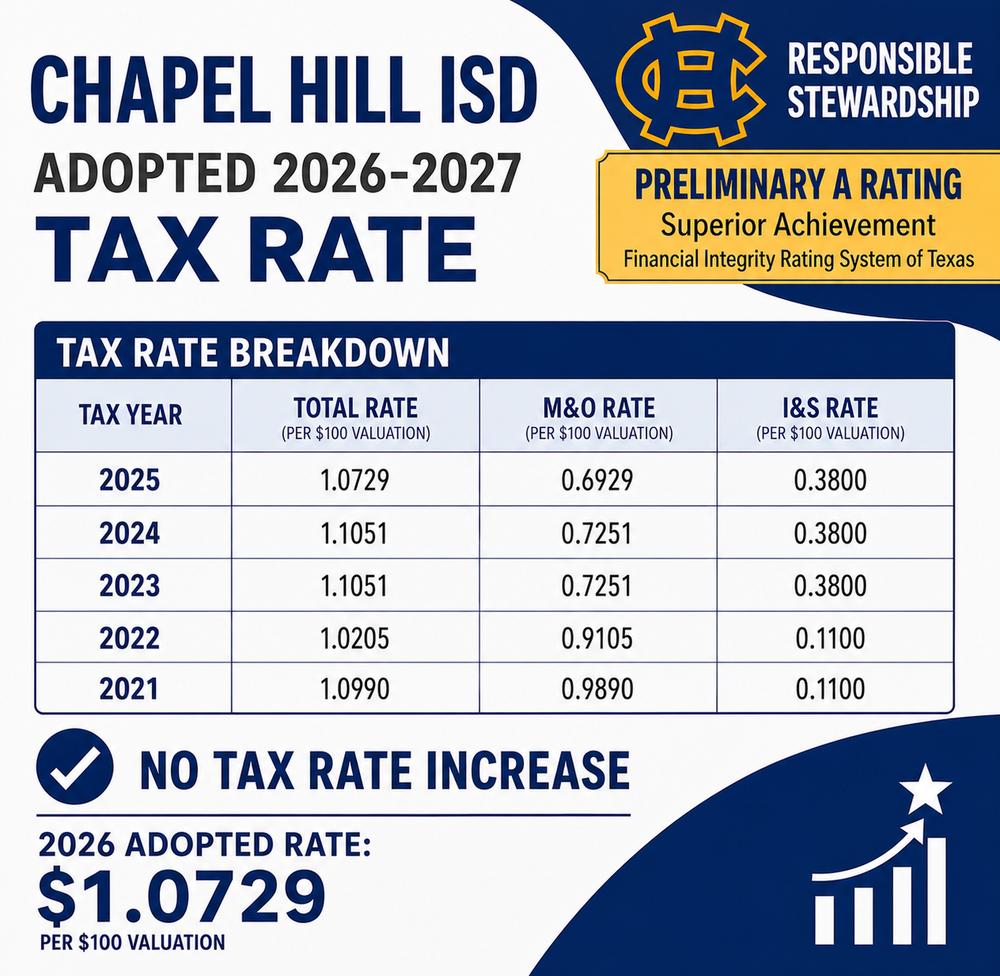
The Chapel Hill ISD Board of Trustees adopted the district’s 2026–2027 tax rate during its August board meeting, continuing the district’s commitment to responsible financial stewardship.
The adopted rate is $1.0729 per $100 of property valuation, representing no increase from the previous year’s rate. The total rate consists of $0.6929 for maintenance and operations and $0.3800 for interest and sinking.
The maintenance and operations portion funds the district’s daily operations, including classroom instruction, employee salaries, utilities, transportation and other essential services. The interest and sinking portion is used to repay voter-approved debt associated with district facilities and capital projects.
The adopted rate reflects Chapel Hill ISD’s ongoing work to carefully manage taxpayer resources while supporting the programs, services and learning environments students and staff need to succeed.
The district also recently received a preliminary A rating for Superior Achievement through the Financial Integrity Rating System of Texas. Commonly known as School FIRST, the state’s financial accountability system evaluates the quality of a school district’s financial management practices and its ability to meet established standards.
Chapel Hill ISD leaders develop the annual budget and tax rate by reviewing projected enrollment, state and local funding, operational needs, debt obligations and long-term district priorities. The process is designed to balance the needs of students and employees with the district’s responsibility to remain accountable to local taxpayers.
The Board of Trustees reviews and adopts the district’s budget and tax rate annually in accordance with state requirements. Public notices, financial documents and board meeting materials are made available to keep families, employees and community members informed throughout the process.
Chapel Hill ISD remains focused on using its financial resources responsibly, maintaining transparency and making decisions that support student achievement and the district’s long-term stability.